


The impact of the war on tennis in Ukraine: financial aid, foundations, governing bodies and all‑round headaches
Since February 2022 and the invasion of Ukraine by Russia, Ukrainian sport has been heavily affected by human, structural and economic losses.
Tennis has, of course, not been spared.
While Ukrainian athletes have had to rethink their entire organization, an entire country, behind the scenes, has had to adapt and change its training conditions. This extends all the way to the highest level, where professional players have spoken out, trying as best they can to help their nation.
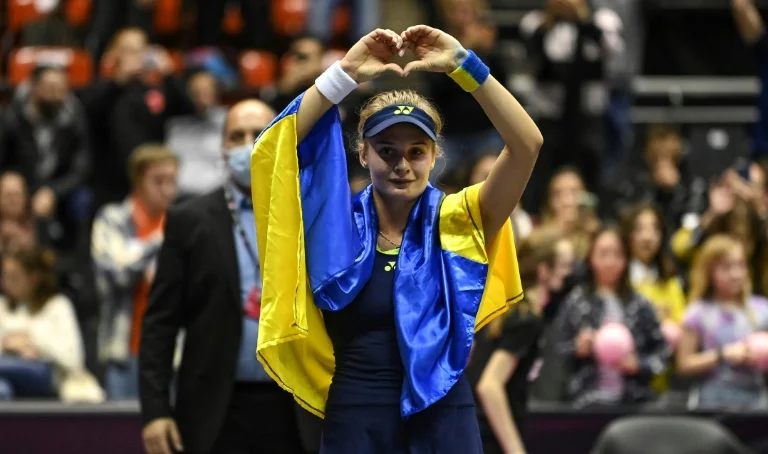


WHAT IS THE IMPACT OF THE WAR ON SPORT IN UKRAINE?
For nearly four years now, Ukrainian athletes have seen their daily lives turned upside down at every level. First, on a personal level of course, with families remaining in Ukraine, which creates anxiety for the athletes concerned, but especially on a professional level. A large number of sports facilities have been destroyed since the start of the conflict, and many human losses must also be mourned.
According to the Ukrainian Ministry of Sports, the country “has lost more than 595 athletes, coaches and youth leaders. 734 sports facilities have been damaged or completely destroyed, including 18 national Olympic and Paralympic bases. In December 2024, total infrastructure losses exceeded 374 million dollars,” reads a statement released on May 15, 2025.
7 million euros to build a national tennis center
To try to start building the Ukraine of tomorrow right away, the country’s sports authorities decided in August 2023 to allocate a budget of 7 million euros to build a national tennis center in the capital Kyiv using an abandoned ice rink, according to information gathered at the time by the media outlet Racket One.
Generally speaking, all the country’s money has been invested in the army to enable Ukrainian soldiers to defend their land at all costs since the beginning of the war on February 24, 2022.
The decision to allocate a multi‑million‑euro budget to tennis raised hackles at the time, as the entire country, not just in the field of sport, will have to be rebuilt in the coming years. According to the figures, the money used to rebuild tennis courts could have been used to buy about 2,300 drones that would have been useful to the Ukrainian army.
“Funding tennis courts must be banned”
“It is unacceptable to carry out major repairs of tennis courts while Ukraine is at war. This money is needed by the armed forces: ammunition, first‑aid kits, drones, weapons, food… It’s about preserving the Ukrainian nation.
The funding of repairs to tennis courts must be banned. You know, I communicate with our military almost every day, and all they talk about is the need for pick‑ups, spare parts… the list is long. When I hear about 7 million euros, my mind automatically calculates how many of these needs could be covered for our military.
Personally, I support the idea of modern sports facilities, but spending such a sum of money right now just doesn’t seem appropriate to me,” Ukrainian activist Maria Barabash said in 2024.
HOW HAVE TENNIS PLAYERS BEEN ORGANIZING SINCE THE WAR?
Athletes generally travel a lot, but one of the sports most affected by air travel during the year is undoubtedly tennis. The greatest player in her country’s history, men and women combined, Elina Svitolina is the symbol of Ukraine’s success in tennis.
A former world No. 3, she has won four WTA 1000 tournaments, the WTA Finals in 2018 and an Olympic bronze medal at the Tokyo Games in 2021, among other achievements. At the forefront of women’s tennis, the 31‑year‑old player was one of the first to take a stand in favor of excluding Russian and Belarusian athletes from official WTA competitions.
In March 2023, as she was preparing to return to the tour after her pregnancy, she gave an interview to the local media “Kyiv Post,” in which she assessed the sporting situation in her country.
“Many went to the front, and some have died”
“The overall situation is very sad for Ukrainian sport. All sports have fallen ten years behind on every level. After all, our athletes can’t train normally now, many went to the front, and some of them have died,” she lamented at the time.
“But in general, there has been no real development of tennis in Ukraine. Everyone is looking for their own way to break through in world tennis. There are patrons who help some players, but there is no help from the Tennis Federation in Ukraine. The recovery of sport will be gradual,” she continued.
“Creating opportunities for future generations”
To help Ukrainian tennis, Elina Svitolina and Marta Kostyuk, another key figure in the sport since she is currently in the world top 30, both created a foundation to enable Ukrainian children and young athletes to play tennis and even do sports in general.
Launched in 2019, the Elina Svitolina Foundation is a charitable organization whose main objective is to develop sport, particularly tennis, support young talents and promote Ukraine on the international stage. “The Foundation is committed to creating opportunities for future generations, using sport as a tool to foster positive and lasting change,” can be read on its official website.

Svitolina, deeply committed to her country on and off the court, was also appointed ambassador of United 24, an organization founded a few years ago by Ukrainian President Volodymyr Zelensky to raise funds to rebuild the country once the war is over.
For her part, Kostyuk created a foundation that developed a program with the aim of integrating it into physical education classes taught in schools in Ukraine. In the long term, the goal is to enable 4,500 children/students who previously had no access to sport to benefit from this program in more than fifteen schools.
WHAT SUPPORT ROLE FOR TENNIS GOVERNING BODIES?
Becoming the first Ukrainian male player to reach the semifinals of an ATP tournament since Alexandr Dolgopolov in 2017, at the final edition of the Metz tournament on the main tour, Vitaliy Sachko also described some behind‑the‑scenes realities: “The war has affected all Ukrainians, my family still lives there. I was raised and have lived in the Czech Republic since my childhood. From the start, I’ve stayed in contact with my family, but as soon as I read the news about what’s happening, I feel like crying.
The war has had a huge impact on men’s tennis in Ukraine (Dolgopolov and Stakhovsky, former world No. 13 and No. 31, have been on the front for their country since 2022). Some have had to fight to survive, but it’s a delicate situation. Sport and other areas of society have taken a back seat financially, there is less and less financial investment because everyone is donating to try to help the army, which is normal,” Sachko explained.
ATP and WTA at the center of the conflict debates
He also stated that the ATP (the players’ association that runs the ATP Tour) made a gesture in 2022 for Ukrainian players, but that in the long run they have had to fend for themselves. That is not so simple, because only the best‑ranked players who regularly play the top tournaments (mainly the Grand Slams and Masters 1000s) can make a living from tennis.

“At first, we received enormous support, especially financial, from the ATP. From what I know, all the Ukrainian players received it. But time passed, and everyone started to get used to what was happening, even though the war continues in Ukraine.
Fewer and fewer people talk about it, and they consider it to have become something ordinary, which is sad. Now, we no longer have any support (from the ATP). We have to fend for ourselves,” regrets the 28‑year‑old player, his country’s No. 1 in men’s singles, who reached a career‑high of world No. 164 after his excellent run in Metz.
If the ATP supported Ukrainian athletes in the first months of the war, that does not seem to be the case for the WTA, at least according to Lesia Tsurenko. In 2023, at the WTA 1000 tournament in Indian Wells, Steve Simon, the former CEO of the body that manages the women’s professional circuit, allegedly made inappropriate remarks about the situation in Ukraine, which Tsurenko witnessed.
“Protecting myself as a Ukrainian woman”: Tsurenko takes aim at the WTA
The 36‑year‑old player, who has not played on the main tour since November 2024, decided to sue the WTA, arguing in particular that it did not provide sufficient support to Ukrainian athletes.
To justify her actions, Tsurenko criticized Simon and the entire WTA structure: “The goal is partly to protect myself as a member of the Ukrainian tennis team and as a Ukrainian woman.
The central issue can be summed up in terms of ‘negligent treatment.’ I spoke publicly about the awkward conversation I had with the former WTA CEO, Steve Simon, in Indian Wells in 2023. It’s no secret. He said certain things to me. I went through a long internal process.
Even in Indian Wells, I contacted every possible WTA representative: the psychologist, the WTA vice president, the supervisors, the player relations staff and the head of security.

Everyone heard what had happened and knew what had taken place. But nothing was done. That alone brought me to tears, because what he told me was terrifying. And it was completely ignored. [...]
In this lawsuit, I address the issue of the WTA’s negligence toward Ukrainian athletes during an incredibly difficult period and the moral damage I suffered. I am not asking for Russian or Belarusian players to be banned; that is not part of the complaint.
“My Instagram account flooded with horrible messages”
There is not a single word about that. My Instagram account has been flooded with messages from people who have completely lost their minds, some people said horrible things. They think I’m suing to get Russians and Belarusians banned. That is not what this is about at all,” the main figure explained in April 2025 to the media outlet Tribuna.
The WTA then responded to Tsurenko shortly afterward via a press release: “Consistent with our position, the WTA has taken numerous steps to assist our Ukrainian players, who have faced great challenges as professional athletes.
The WTA has also made it clear that it was founded on the principles of equality and non‑discrimination and that its rules state that competitions are open to all players who qualify on the basis of their merits, without discrimination. In line with these principles, and similar to other tennis organizations, the WTA has adopted the position that individual athletes should not be penalized for the actions of their governments.”
HUMAN, ECONOMIC AND PSYCHOLOGICAL IMPACTS: DAILY LIFE UPENDED BY WAR
On February 25, 2025, three years and one day after the start of the war, a study by the United Nations showed that the cost of a full reconstruction of Ukraine is estimated at 524 billion dollars over the next decade.
In this context, all areas of society are affected, including sport. Ukrainian athletes, some of whom have died defending their country on the front, have seen their training routines disrupted since 2022.
As for tennis, a sport in which only the world’s top 100 or so can make a living financially, athletes have been left to their own devices. They have to figure things out themselves to give young people opportunities, thanks in particular to the foundations launched a few years ago by the leading figures in Ukrainian tennis, namely Elina Svitolina and Marta Kostyuk.
The psychological aspect is also something that should not be underestimated, and the course of the war led Lesia Tsurenko to file a lawsuit against the former WTA CEO.
The professional tennis governing bodies, led by the ATP and the WTA, also have a role to play in adapting to this conflict situation, but their involvement seems to be weakening as the situation becomes more ordinary in the eyes of society.
Tennis in Ukraine can obviously only be relegated to the background in a force majeure situation like this. And it will no doubt remain deeply marked by this dark period, despite the many efforts made to allow it to continue to exist, against all odds.


